NoSQL (“Not Only SQL”) is a category of databases designed to store semi-structured and unstructured data without the rigid table schemas of relational databases. Key-Value stores—the simplest and fastest NoSQL model—organize data as associative arrays where a unique key points directly to its value, enabling lookups in microseconds rather than milliseconds.
Modern applications handle continuous streams of dynamic information—user preferences, active sessions, geolocation data, real-time analytics. Traditional relational databases, while robust for transactional integrity, often struggle to scale and respond with the velocity these workloads demand.
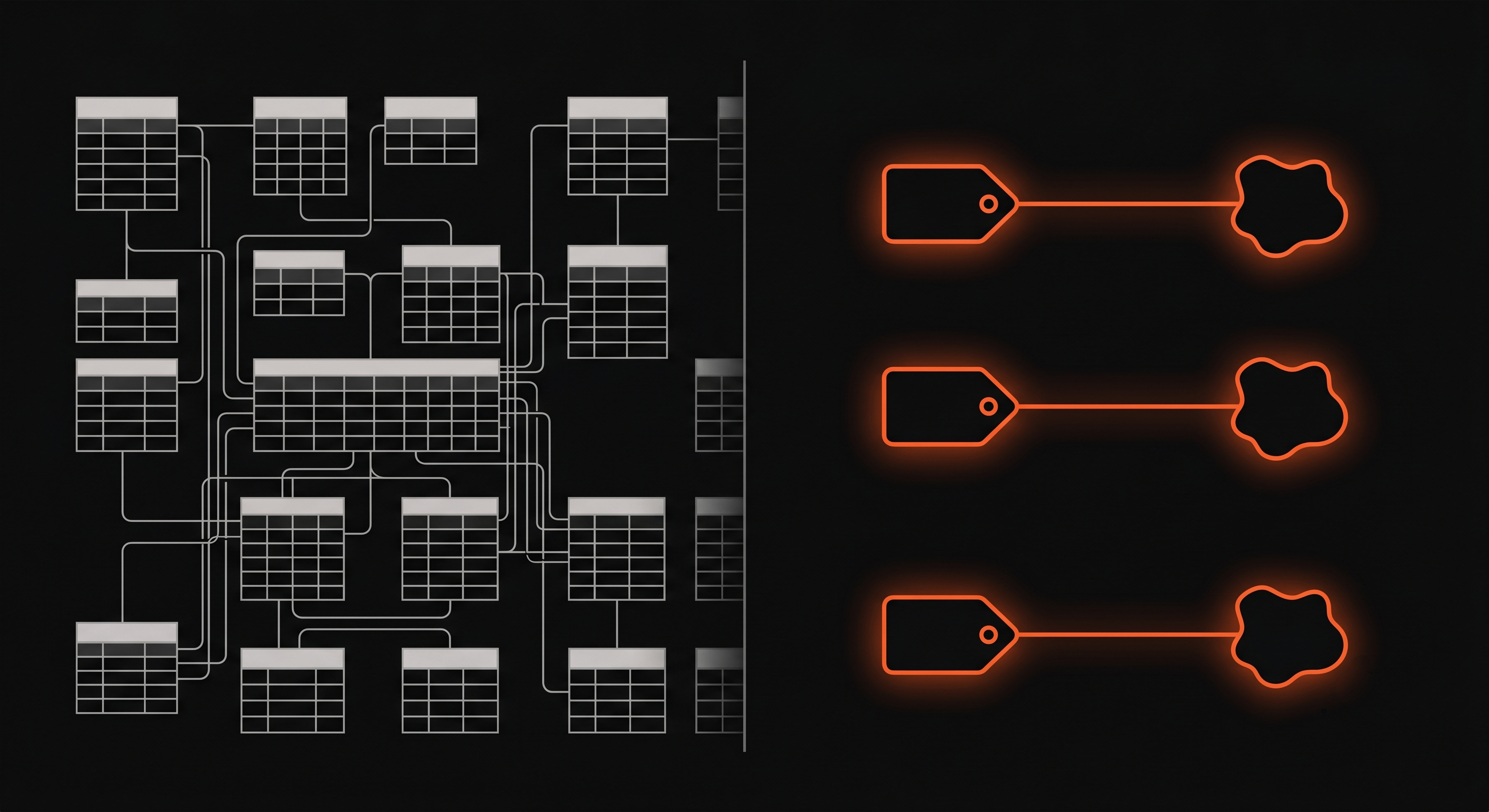
What is NoSQL? The Evolution of Non-Relational Databases
A NoSQL database (“Not Only SQL”) is a storage system designed to manage large volumes of data that don’t fit the rigid structure of tables with fixed columns and rows. Instead of enforcing a predefined schema before data enters, NoSQL systems accept flexible, semi-structured formats—JSON documents, key-value pairs, graph nodes—that can evolve without complex migration scripts.
Why NoSQL Emerged
The term originated in the late 2000s as web applications scaled to serve millions of concurrent users. Relational databases, designed for transactional consistency on single servers, faced fundamental limits when distributed across global infrastructure.
NoSQL systems prioritized different goals:
- Horizontal scalability: Add capacity by adding servers to a cluster, not by upgrading a single machine
- Schema flexibility: Change data structure without altering database schemas or running migrations
- High throughput: Optimize for read/write velocity over strict transactional consistency
- Developer velocity: Iterate quickly without database administration overhead
Analogy: If a relational database is like a filing cabinet with labeled folders and strict organizational rules, a NoSQL database is like a warehouse where you can store boxes of any size and shape without reorganizing the entire facility. Each box can contain different items, and you can add new box types without relabeling every existing folder.
The Four Fundamental NoSQL Models
NoSQL isn’t a single technology—it’s a category containing distinct data models optimized for different workloads:
Document Stores organize data as semi-structured documents, typically JSON or BSON. Each document contains its own schema—fields can vary between documents in the same collection. This flexibility suits content management systems, user profiles, and product catalogs where each record may have different attributes.
Wide-Column Stores group data by column families rather than rows. This structure optimizes analytical queries that aggregate specific fields across millions of records. Use cases include time-series data, IoT telemetry, and log analytics where you query specific columns rather than complete records.
Graph Databases map entities as nodes and their relationships as edges. They excel at traversing connections—finding friends of friends, detecting fraud rings, recommending products based on network patterns. Social networks, knowledge graphs, and recommendation engines rely on graph architectures.
Key-Value Stores represent the most minimal, fastest model—pairs of unique identifiers (keys) and their associated values. No joins, no schema validation, no complex query parsing. Just direct lookups and writes at microsecond speeds.
What is a Key-Value Store? The Ultra-High-Speed Data Model
A Key-Value Store is a database that organizes information as associative arrays: each unique key (typically a string identifier) maps directly to a value (any data type—strings, binary blobs, JSON objects, serialized data).
The model eliminates everything that slows down traditional databases:
- No table joins across multiple data structures
- No schema validation before writes
- No query parsing or execution planning
- No complex indexing strategies
How Key-Value Lookups Work
The speed of key-value stores comes from two distinct mechanisms working together:
In-memory hash tables enable direct lookups with constant time complexity—meaning the lookup time stays the same regardless of how many items exist in the database. The system applies a hash function to your key, generating a deterministic numeric value that points directly to the memory location containing your data. No searching through indexes. No joining tables. The key becomes the address.
Distributed systems use consistent hashing to route requests across multiple servers. When data replicates across global Points of Presence, consistent hashing determines which server (or partition) holds each key’s data. This algorithm minimizes data movement when nodes join or leave the cluster—only a fraction of keys remap, preserving locality.
Analogy: Think of a hotel cloakroom. You hand over your coat and receive a numbered ticket (the key). To retrieve your coat (the value), you present the ticket. The attendant doesn’t search through every coat or ask what’s inside—they simply fetch the coat associated with your ticket number. Instant retrieval because the relationship is direct.
Opaque Values: What the Database Actually Stores
Key-value stores treat values as opaque data—raw byte sequences without internal structure. The database engine doesn’t parse, validate, or understand what’s inside the value. It simply stores bytes and returns them when requested.
When you see code that stores and retrieves JSON objects, the magic happens at the application layer, not inside the database:
// The application serializes the object to a string before sendingconst sessionData = {  userId: '847291',  lastAccess: Date.now(),  preferences: { theme: 'dark', language: 'en' }};
// SDK automatically serializes to: '{"userId":"847291","lastAccess":1748438400000,"preferences":{"theme":"dark","language":"en"}}'await kv.set('session:user_847291', sessionData, { ttl: 3600 });
// SDK deserializes back to object on retrievalconst session = await kv.get('session:user_847291');console.log(session.preferences.theme); // 'dark' - SDK parsed the JSON
The database stores only the serialized string. The SDK (software development kit) handles serialization and deserialization transparently. This separation keeps the database engine simple and fast—the application layer handles structure interpretation.
Key Design and Namespacing
Effective key design prevents collisions and organizes data logically. A common pattern uses namespace prefixes with delimiter characters:
// Namespace pattern: {entity_type}:{identifier}:{attribute}'session:abc123' // User session by token'user:847291:preferences' // User preferences by ID'ratelimit:api:user_847291' // Rate limit counter'feature:checkout_v2' // Feature flag'redirect:promo2024' // URL redirect mappingThis pattern enables:
- Logical grouping: All session keys start with
session: - Collision avoidance: Different entity types won’t conflict
- Pattern scanning: Some key-value stores support listing keys by prefix (though this is an extended feature, not core to the model)
Time-to-Live (TTL): Automatic Data Expiration
Key-value stores include a critical feature for distributed systems: TTL (Time-to-Live). Each key can have an expiration timestamp. When TTL elapses, the system automatically deletes the key-value pair.
This capability enables:
- Session management: User sessions expire automatically after inactivity
- Rate limiting: Counters reset after time windows
- Cache invalidation: Stale data removes itself without manual cleanup
- Temporary tokens: Authentication tokens expire on schedule
Without TTL, applications would need background processes to scan and delete expired data—a resource-intensive operation at scale. With TTL, expiration happens automatically as part of the store’s normal operation.
SQL vs. NoSQL: A Comparative Framework
Understanding when to choose each model requires examining their fundamental differences:
| Aspect | Relational (SQL) | Non-Relational (NoSQL) |
|---|---|---|
| Data Model | Tables with rows and columns | Documents, key-value pairs, graphs, or column families |
| Schema | Fixed, defined upfront (migrations required for changes) | Flexible, schemaless or dynamic schemas |
| Scalability | Vertical (scale-up: bigger server) | Horizontal (scale-out: more servers) |
| Consistency | Strong (ACID transactions) | Tunable (eventual to strong, per CAP theorem) |
| Query Language | SQL (standardized, declarative) | API-based or proprietary query methods |
| Relationships | Primary/foreign keys with JOINs | Embedded documents or application-level joins |
| Use Cases | Financial systems, ERP, inventory management | Sessions, real-time analytics, content management, IoT |
SQLite deserves special mention: As a single-file database, SQLite locks the entire file during write operations. Only one writer at a time. This makes SQLite excellent for read-heavy workloads, but unsuitable for high-volume concurrent write systems. Applications like content management, user preferences, and configuration storage benefit from SQLite’s speed and portability. High-transaction financial systems need traditional server-based databases.
Note on distributed SQLite: SQLite read replication at global Points of Presence is not a native feature of SQLite itself. The core engine is fundamentally local and single-file. Distributed read replication is an abstraction provided by modern edge-native database runtimes and extensions that wrap the SQLite engine—coordinating replicas, managing synchronization, and presenting a unified interface. When evaluating distributed SQLite solutions, understand that the replication layer sits outside the core database.
Relational Database vs. Key-Value Store: Architectural Trade-offs
The choice between SQL and Key-Value isn’t about one being better—it’s about matching the tool to the workload.
Consistency vs. Speed
Relational databases enforce strong consistency through ACID properties. When you write data, the transaction doesn’t confirm until all constraints validate and all indexes update. This guarantee protects financial transactions, inventory systems, and user authentication where accuracy is non-negotiable.
Key-Value stores prioritize speed over immediate consistency. Writes confirm instantly at the local node. Updates propagate asynchronously to other nodes in the cluster. This pattern—eventual consistency—means different users might see slightly different data for brief periods, but operations complete in microseconds rather than milliseconds.
The CAP Theorem: The Physics of Distributed Data
The CAP Theorem, formulated by Eric Brewer, states that a distributed system can guarantee only two of three properties simultaneously:
- Consistency (C): All nodes see the same data at the same time
- Availability (A): Every request receives a response (success or failure)
- Partition tolerance (P): The system continues operating despite network failures
In real-world distributed systems, network partitions are inevitable. This forces a choice between consistency and availability when partitions occur.
SQL databases designed for distributed architectures typically choose Consistency—all nodes must agree before a transaction confirms. This ensures data accuracy but may introduce latency during synchronization or network issues.
Key-Value stores designed for distributed architectures typically choose Availability—the local node accepts reads and writes immediately, synchronizing with other nodes asynchronously. Users always get responses, but may see stale data temporarily.
Eventual Consistency Decoded
Eventual consistency means that, given enough time without new writes, all replicas in a distributed system converge to the same state. The key insight: most applications tolerate brief inconsistencies for specific data types.
Consider a shopping cart. If a user adds an item and their session replicates globally within 500 milliseconds, the experience remains seamless. The user doesn’t notice that a server in another region briefly showed an older cart state. This pattern relies on a clear separation of concerns: the eventual-consistent key-value store manages fast-changing session state at the network edge (adding items to the cart), while a strongly-consistent transactional database (SQL) takes over during checkout to validate final inventory and process the payment. What matters is that the cart updates before the consistency boundary—not that every replica agrees instantly.
For financial transfers, inventory decrements, or authentication tokens, strong consistency remains essential. For session state, feature flags, analytics counters, and cached content, eventual consistency provides acceptable user experience with superior latency.
Key-Value Store vs. Document Store: When to Use Each
Both models fall under NoSQL, but they serve different access patterns.
The Fundamental Difference
Key-Value stores treat values as opaque data. The database doesn’t understand what’s inside the value—it just stores and retrieves bytes. You can only query by the exact key. No partial matches, no field searches, no range queries within values.
Note on modern extensions: Some popular key-value engines offer extended features like the SCAN command for iterating keys by pattern, sorted sets for ranked data, or search modules for full-text indexing. These are add-on capabilities, not core to the key-value model. The fundamental constraint remains: pure key-value stores require knowing the exact key for retrieval.
Document stores understand the structure of values. They parse JSON documents, index fields, and enable queries based on document content. You can find all documents where status = "active" or age > 25 without knowing document IDs.
When to Choose Key-Value
Select a Key-Value store when:
- You always access data by a known identifier (user ID, session token, URL slug)
- You need the lowest possible latency for reads and writes
- Your data model is simple: one key, one value
- You don’t need to search within values
- You want automatic expiration (TTL) for transient data
Common use cases: Session storage, caching, rate limiting counters, feature flags, URL redirects, API tokens.
When to Choose Document Store
Select a Document store when:
- You need to query data by fields other than the primary identifier
- Your data has nested structures you want to index
- You perform aggregations across documents
- Your schema evolves frequently but you still need query capability
- You want to retrieve partial documents (specific fields)
Common use cases: User profiles with searchable attributes, product catalogs with filtered browsing, content management with full-text search, analytics with grouped aggregations.
Performance Comparison
| Operation | Key-Value Store | Document Store |
|---|---|---|
| Write by key | 0.5-2ms | 2-10ms |
| Read by key | 0.5-2ms | 1-5ms |
| Query by field | Not possible (core model) | 5-50ms |
| Complex aggregation | Not possible | 10-200ms |
| Schema flexibility | Maximum (opaque values) | High (JSON structure) |
Methodological note: The latency figures above reflect typical distributed cloud deployments where data resides at a local or proximal Point of Presence. These microsecond-to-millisecond lookups represent in-memory execution or nearby edge node access under optimal conditions. Traditional cross-region database queries—where a user in São Paulo queries a database in Virginia—introduce physical propagation latency of 10–200ms depending on geographic distance, network hops, and congestion. The key-value advantage compounds when data replicates globally: local lookups avoid the round-trip entirely.
Key insight: Key-value stores sacrifice query flexibility for speed. Document stores add query capability at the cost of latency. Choose based on whether your application needs to search within data or only retrieve by identifier.
Key-Value Store Use Cases on Distributed Architecture
Deploying key-value stores on a distributed architecture—with data replicated to global Points of Presence—unlocks specific patterns that would be prohibitively slow with centralized databases.
User Session Management
When users log in, their session data (authentication status, preferences, cart contents) must be available for every subsequent request. Storing sessions in a centralized database adds latency to every page load.
Distributed key-value solution: Session data replicates to PoPs worldwide. When a user in Tokyo makes a request, their session retrieves from a local node in milliseconds, not from a database in Virginia.
// Session storage pattern with namespaced keysconst sessionId = generateSecureToken();await kv.set(`session:${sessionId}`, {  userId: user.id,  authenticatedAt: Date.now(),  cart: [],  preferences: user.preferences}, { ttl: 86400 }); // 24-hour expiration
// Subsequent requests retrieve session locallyconst session = await kv.get(`session:${sessionId}`);if (!session || Date.now() - session.authenticatedAt > 86400000) {  redirect('login-page');}
URL Redirection and Traffic Routing
URL shorteners, marketing campaign links, and dynamic routing tables rely on key-value lookups. The key is the short URL slug; the value is the destination URL.
Distributed advantage: Redirects happen at the network edge, closest to the user. No round-trip to a central database. The lookup completes in microseconds, and the redirect begins immediately.
Feature Flags and A/B Testing Configuration
Feature flags control application behavior without code deployments. A/B tests route users to different experiences based on configuration values.
Distributed key-value pattern: Store feature flag configurations in a key-value store with global replication. Applications read flags from local PoPs, enabling instant configuration changes without database queries to centralized servers.
// Feature flag retrieval with namespaced keyconst flags = await kv.get('flags:production');if (flags.newCheckout && user.inCohort('beta')) { renderNewCheckout();} else { renderClassicCheckout();}Rate Limiting and API Quotas
API rate limiting requires counting requests per user, per endpoint, per time window. Key-value stores with atomic increment operations handle this efficiently.
Critical pattern: The rate limiting code must handle TTL atomically to avoid race conditions. If the application crashes between incrementing a counter and setting its expiration, the key persists indefinitely—blocking the user permanently.
Safe approaches for atomic rate limiting:
// Safe rate limiting: atomic operations prevent race conditionsconst windowStart = Math.floor(Date.now() / 60000); // Current minuteconst key = `ratelimit:api:user_${userId}:${windowStart}`;
// Option 1: Using an edge-native KV platform with built-in atomic increment-with-TTL// This is the preferred approach when available - a single atomic operation// combines the increment and TTL setting, eliminating any race condition windowconst count = await kv.incrWithTtl(key, 60); // Atomic increment + 60s TTL
// Option 2: For traditional key-value stores without atomic increment-with-TTL// Set TTL only on first write (when incr returns 1, the key was just created)const count = await kv.incr(key);if (count === 1) {  // Safe: only set TTL once at key creation  // Subsequent increments won't reset the expiration  await kv.expire(key, 60);}
if (count > 100) {  return { status: 429, error: 'Rate limit exceeded' };}
Why Option 2 works: The incr command returns 1 only when creating a new key. Setting TTL at that moment is safe because subsequent increments return values greater than 1, so the TTL-setting code path never executes again. Traditional key-value stores like Redis use transactions or Lua scripts to combine SET key value EX seconds and INCR atomically—the same principle applies here.
Data Security Considerations
Moving databases and caches to a distributed architecture reduces latency for users but expands the logical attack surface. Data now exists in multiple locations simultaneously, each representing a potential entry point. The convenience of global replication introduces new considerations for access control, data integrity, and attack prevention.
Injection Risks in NoSQL Systems
NoSQL injection varies significantly by database architecture—there is no single attack pattern:
Document databases face injection risks through query operator manipulation. Attackers inject JSON expressions or database-specific operators that alter query logic. For example, in systems that accept JavaScript-style query syntax, an attacker might submit {"$ne": null} or {"$gt": ""} to bypass authentication filters. Each document store has its own query language and operator set, making injection patterns specific to the technology.
Key-value stores present a different threat model. Since the database engine doesn’t parse values, traditional query injection doesn’t apply. However, key-value stores face these specific risks:
-
Key enumeration and IDOR: Predictable key patterns like
session:user_1,session:user_2allow attackers to guess valid keys and access other users’ data (Insecure Direct Object Reference). Use cryptographically random identifiers, not sequential numbers. -
Key namespace hijacking: Malicious keys designed to collide with or overwrite legitimate data. An attacker might inject
session:admin_tokenif the application doesn’t properly namespace keys by user context. -
Untrusted deserialization: When applications deserialize stored values, malicious payloads can exploit the deserialization process. JavaScript prototype pollution, Python pickle exploits, and similar attacks target the application layer that parses values—not the database itself.
-
TTL manipulation: Exploiting expiration policies to cause denial of service or force premature data eviction.
-
Server-side script execution: Some advanced key-value engines support server-side scripting (for example, Lua scripts via EVAL commands). These reintroduce injection surfaces similar to SQL stored procedures—untrusted input passed to server-side code can execute arbitrary logic.
Prevention requires:
- Input validation: Sanitize all keys and values before storage; reject predictable key patterns
- Namespace isolation: Use key prefixes to separate tenant or application data
- Least privilege: Database accounts with minimal necessary permissions
- Encryption: Protect data at rest (AES-256) and in transit (TLS 1.3)
- Secure deserialization: Never deserialize data from untrusted sources; use safe formats like JSON with strict parsers
Mini FAQ: Quick Reference
What is a distributed Key-Value Store?
A distributed Key-Value Store replicates data across multiple geographic locations (Points of Presence). Each location holds a copy of the key-value pairs, serving read requests locally. Writes propagate asynchronously between nodes. This architecture reduces latency for global users while maintaining high availability.
Can a Key-Value Store be my primary database?
Yes, for applications with simple data models based on key-based access patterns. Session management, caching layers, and configuration storage work well with key-value stores as the primary persistence layer. Applications requiring complex queries, relationships between entities, or transactional integrity should use relational databases or document stores as the primary system, with key-value stores as an acceleration layer.
What’s the difference between a cache and a Key-Value Store?
The distinction is often a matter of configuration, not architecture. Both systems store key-value pairs. The difference lies in:
- Persistence: Key-value stores typically write to disk; caches often keep data only in memory
- Eviction policies: Caches automatically evict data when memory fills (LRU, LFU); key-value stores keep data until explicitly deleted or TTL expires
- Durability: Key-value stores survive restarts; caches lose data on restart unless configured for persistence
Many systems blur this line. A cache configured with disk persistence and TTL behaves like a key-value store. A key-value store configured with memory-only storage and LRU eviction behaves like a cache. Choose based on your durability requirements, not the label.
How do I migrate from a relational database to a Key-Value Store?
Migration requires denormalizing data. In relational databases, you normalize to eliminate redundancy. In key-value stores, you denormalize for fast retrieval by key.
Steps:
- Identify access patterns—what data do you retrieve together?
- Design keys that match your lookup patterns (use namespace prefixes)
- Flatten joined data into single values
- Accept that some data will duplicate across keys
- Implement TTL for data that should expire
Not all relational data fits key-value models. Complex relationships and ad-hoc queries remain better suited for SQL databases.
Why is SQLite popular for distributed read-heavy workloads?
SQLite requires no server process, stores everything in a single file, and runs anywhere. This portability makes it ideal for serverless functions and embedded deployments. The core limitation: SQLite locks the entire file during writes, making it unsuitable for high-volume concurrent write systems.
Important clarification: SQLite read replication at global Points of Presence is not a native SQLite feature. The SQLite engine is fundamentally local—a single file on a single machine. Distributed read replication requires external coordination layers provided by edge-native database runtimes that wrap the SQLite engine, manage replica synchronization, and present a unified interface. When evaluating distributed SQLite solutions, recognize that the replication infrastructure sits outside the core database.
Key Takeaways
- NoSQL databases emerged to handle semi-structured data and horizontal scaling requirements that relational databases struggle with at global scale.
- Key-Value stores provide the simplest, fastest NoSQL model—direct lookups by unique identifiers with microsecond latency.
- The CAP theorem forces a choice between consistency and availability in distributed systems. Key-value stores typically prioritize availability with eventual consistency.
- Key-Value vs. Document stores: Choose key-value for speed when you access data only by key; choose document stores when you need to query within data fields.
- Distributed architecture amplifies key-value advantages by placing data close to users globally, enabling session management, rate limiting, and feature flags at network-edge speed.
Conclusion
Choosing the right database model defines the performance ceiling of your application. NoSQL databases—and Key-Value stores specifically—address workloads where velocity and horizontal scale matter more than complex queries and strict consistency.
The Key-Value model’s simplicity is its strength. By eliminating joins, schema validation, and query parsing, key-value stores deliver consistent microsecond latency that scales linearly across distributed infrastructure. This makes them ideal for session management, rate limiting, feature flags, and any workload where you know the key and need the value immediately.
As applications evolve to serve global users with minimal latency, distributed key-value stores bridge the gap between data persistence and network-edge speed—bringing stateful data as close to users as static content.
For implementations requiring distributed key-value storage with global replication, KV Store provides serverless key-value storage positioned at the network edge.
Related Topics
Continue exploring the Storage and Database cluster:
- What is Storage and Database? — The complete landscape of data storage technologies
- What is a Relational Database? — SQL, ACID properties, and structured data
- What is Object Storage and Blob Storage? — Unstructured data storage at scale
- What is a Vector Database? — The brain of AI applications
- What is Database Security? — SQL injection and breach prevention