Database security requires defending query pathways against injection attacks and protecting the storage layer against unauthorized breaches. Organizations that implement parameterized queries, encryption at rest and in transit, and Zero Trust architecture significantly reduce their exposure to both SQL injection attacks and data exfiltration incidents.
Databases store an organization’s most valuable assets: customer records, financial transactions, intellectual property, and operational data. As applications distribute across global infrastructure and data moves closer to users through Points of Presence worldwide, safeguarding database pathways becomes a primary operational necessity.
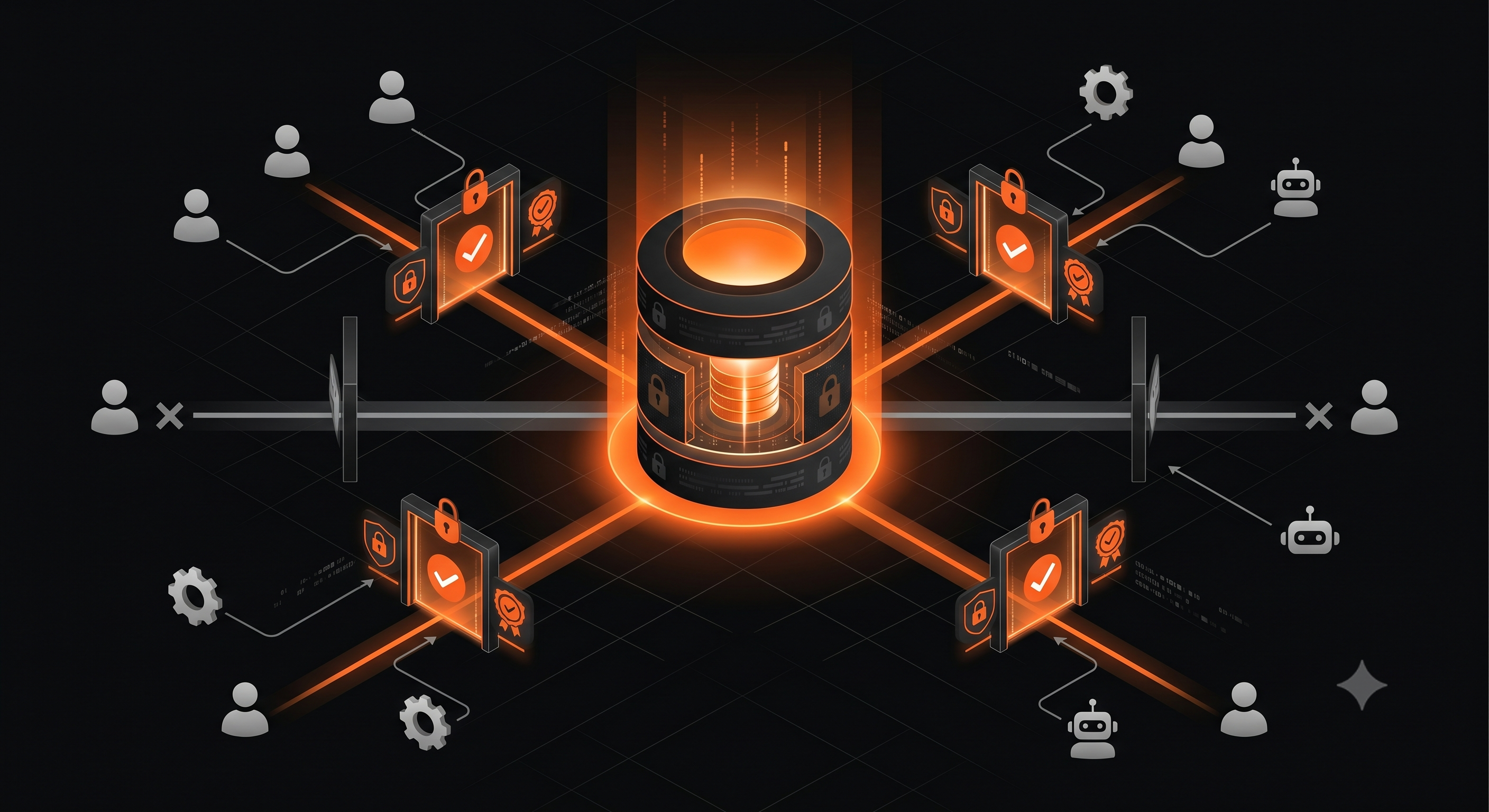
Every database interaction creates two potential attack surfaces: the query layer, where applications send commands to retrieve or modify data, and the storage layer, where data persists on disk or in memory. Attackers target both. SQL injection exploits the query layer by tricking applications into executing malicious commands. Database breaches target the storage layer by gaining unauthorized access to the data itself.
Understanding both attack vectors—and the defenses against them—forms the foundation of modern database security.
What is SQL Injection (SQLi)?
SQL Injection (SQLi) is a code injection technique that exploits unsafe database query construction. When an application concatenates user input directly into SQL statements without proper sanitization, attackers can inject malicious SQL commands that the database executes as legitimate queries.
This vulnerability has persisted for over two decades and remains one of the most common attack vectors against database-driven applications. In the OWASP Top 10 2021, injection vulnerabilities were consolidated into the category A03:2021-Injection, reflecting their continued prevalence and severity in modern web applications.
The Restaurant Order Analogy
Imagine a restaurant where customers write their orders on paper slips. A legitimate customer writes “1 Pizza Margherita.” The waiter reads it and tells the kitchen to prepare one pizza.
Now imagine a malicious customer writes: “1 Pizza Margherita AND also give me all the cash in the register.” If the waiter blindly executes this instruction without questioning it, a theft occurs.
This is exactly what happens with SQL injection. The application acts as the waiter, the database as the kitchen, and the malicious input as the fraudulent order. When applications trust user input without validation, attackers can append commands that the database dutifully executes.
An SQL Injection Example
Consider a login form that validates users by checking credentials against a database. A vulnerable implementation might construct the query like this:
-- Vulnerable query concatenating user input directlySELECT * FROM users WHERE username = 'user_input' AND password = 'password_input';The application takes whatever the user types in the username and password fields and inserts it directly into the query string. This seems harmless until an attacker enters a specially crafted payload.
The attacker enters:
- Username:
' OR '1'='1 - Password:
anything
The resulting query becomes:
SELECT * FROM users WHERE username = '' OR '1'='1' AND password = 'anything';The condition '1'='1' always evaluates to true. The database returns all records from the users table, bypassing authentication entirely. The attacker gains access without knowing any valid credentials.
This basic example demonstrates the core mechanism. Real-world SQL injection attacks can extract entire databases, modify records, delete tables, or even execute operating system commands depending on database configuration.
Types of SQL Injection Attacks
In-band SQL injection (also called classic SQL injection) occurs when attackers use the same communication channel to launch the attack and retrieve results. The malicious payload produces visible results in the application’s response—error messages, data displays, or page content changes.
Blind SQL injection occurs when attackers cannot see the results of their injected queries directly. Instead, they infer information by observing application behavior. This technique requires more requests and patience, but can extract the same data. Blind SQL injection has two primary subcategories:
Boolean-based blind injection relies on true/false conditions. The attacker crafts queries that force the application to return different responses based on whether a condition is true or false. For example, an attacker might inject a condition that causes a product page to display an item when true and show “product not found” when false. By observing these binary responses, the attacker can extract data one bit at a time—asking questions like “Does the first character of the admin password start with ‘a’?” and watching the response.
Time-based blind injection is particularly dangerous because it works even when the application shows no visible differences in output. The attacker injects commands that cause the database to pause for a specified duration—using functions like SLEEP() in MySQL or WAITFOR DELAY in SQL Server. If the response takes several seconds longer than normal, the attacker knows the injected condition was true. This technique succeeds against applications that suppress error messages and display consistent content, making it one of the hardest injection variants to detect and prevent.
Out-of-band SQL injection uses alternative channels to exfiltrate data. Instead of retrieving results through the application’s response, the injected query sends data to an external server controlled by the attacker—through DNS lookups, HTTP requests, or email functions if the database supports them.
How to Prevent SQL Injection Attacks
SQL injection prevention requires treating all user input as untrusted by default and implementing multiple defensive layers. The most effective protection combines parameterized queries, input validation, and least-privilege database access.
Parameterized Queries (Prepared Statements)
Parameterized queries separate SQL code from data, eliminating the possibility of injection. Instead of concatenating user input into the query string, the application defines the query structure with placeholders, then sends the user input as separate parameters.
The sealed envelope analogy: Parameterization works like putting user input inside a sealed, opaque envelope. The database receives the envelope and reads its contents as a literal text value—never as an active command to execute. Even if the envelope contains SQL syntax, the database treats it as plain text.
Vulnerable approach (concatenation):
// DANGEROUS: User input concatenated directly into queryconst query = `SELECT * FROM users WHERE username = '${username}'`;await database.execute(query);Secure approach (parameterization):
// SAFE: User input passed as a separate parameterconst query = "SELECT * FROM users WHERE username = ?";await database.execute(query, [username]);The database driver handles escaping and quoting automatically. The username parameter can contain any characters—including quotes, semicolons, or SQL keywords—and the database will treat it as a literal string value, never as executable code.
This protection works across all programming languages and database systems. Whether using prepared statements in PHP, bound parameters in Python, or parameterized queries in Java, the principle remains identical: code and data travel separately.
Input Validation and Sanitization
Input validation checks whether user input conforms to expected formats before processing. This provides a secondary defense layer, though it should never replace parameterized queries.
Allowlisting (the preferred approach) defines acceptable input patterns and rejects everything else. A username field might allow only alphanumeric characters and underscores. An age field might accept only positive integers. Any input matching the allowed pattern passes; everything else gets rejected.
Denylisting (the problematic approach) attempts to block known dangerous characters or patterns. This approach fails because attackers constantly discover new bypass techniques. A denylist blocking the word “SELECT” can be circumvented with “SeLeCt” or “SELECT/**/” or encoding tricks.
Critical limitation: For free-text fields—such as comment boxes, product descriptions, forum posts, or multilingual content—allowlisting becomes impractical and ineffective. Users legitimately need to type quotes, semicolons, and special characters in these fields. In such scenarios, parameterized queries become the only reliable line of defense. No amount of input filtering can safely handle arbitrary text input; the query structure itself must isolate user data from executable code.
Validation should occur on the server side. Client-side JavaScript validation improves user experience but provides no security—attackers can bypass it by modifying the browser or sending requests directly to the API.
The Principle of Least Privilege
Database accounts used by applications should have the minimum permissions necessary to perform their functions. A web application that only reads product information should use a database account with SELECT permissions only—no INSERT, UPDATE, DELETE, or administrative capabilities.
Why this matters: If an attacker successfully injects SQL into an application using a least-privilege account, the damage remains limited. The attacker cannot:
- Drop tables (
DROP TABLE users) - Delete records (
DELETE FROM users) - Modify data (
UPDATE users SET role='admin') - Access system tables or metadata
- Execute administrative commands
Implementation approach:
- Create separate database accounts for different application components
- Grant each account only the permissions it needs
- Never use database administrator (DBA) accounts for application connections
- Review and audit permissions regularly
Least privilege doesn’t prevent SQL injection—it contains the blast radius when injection occurs.
NoSQL Injection: A Different Attack Surface
SQL injection dominates security discussions because relational databases remain ubiquitous, but NoSQL databases face similar vulnerabilities with different attack vectors. Understanding NoSQL injection completes the security picture for modern data architectures.
How NoSQL Injection Differs
NoSQL databases—document stores like MongoDB, key-value stores like Redis, column-family stores like Cassandra—don’t use SQL syntax. Instead, they accept queries as JSON documents, binary objects, or API calls. Attackers exploit these alternative query formats.
The JSON operator injection: Consider a MongoDB query that authenticates users:
// Vulnerable MongoDB querydb.users.findOne({ username: username, password: password });An attacker might send a password value of {"$ne": null} (meaning “not equal to null”). The resulting query becomes:
// Malicious query after injectiondb.users.findOne({ username: "admin", password: { "$ne": null } });This query finds any user named “admin” whose password is not null—effectively bypassing authentication without knowing the actual password.
Why Parameterization Still Matters
The same defensive principle applies: separate query structure from user data. MongoDB and other NoSQL databases offer query builders and parameterized interfaces that prevent operator injection. The syntax differs, but the vulnerability pattern—concatenating untrusted input into queries—remains identical.
Organizations running both SQL and NoSQL databases must apply injection defenses consistently across all data stores. A single unprotected query endpoint, regardless of database type, creates exploitable risk.
What are Database Breaches?
A database breach occurs when unauthorized parties gain access to stored data through exploitation, misconfiguration, or credential compromise. Unlike SQL injection, which attacks the query layer, breaches target the storage and access control mechanisms protecting data at rest.
The business impact extends far beyond technical remediation. Organizations face regulatory penalties (GDPR fines can reach 4% of annual global revenue), legal liability, reputational damage, and operational disruption. According to the IBM 2023 Cost of a Data Breach Report, the average cost of a data breach reached US$ 4.45 million—not counting long-term customer attrition and brand erosion.
How Leaks Occur: Common Attack Paths
Accidental public exposure represents the most preventable—and unfortunately common—breach vector. Cloud storage buckets, database instances, and administrative interfaces are frequently left accessible to the internet without authentication. Attackers use automated scanning tools to discover these exposures within hours of deployment.
Misconfigurations that cause exposure include:
- Storage buckets with public read permissions
- Database ports (3306 for MySQL, 5432 for PostgreSQL, 27017 for MongoDB) open to all IP addresses
- Default administrative credentials unchanged from installation
- Debug endpoints or admin panels accessible without authentication
- Backup files stored in publicly accessible locations
Weak or stolen administrative credentials provide direct access to database contents. Attackers obtain credentials through:
- Phishing attacks targeting database administrators
- Credential reuse from other breached services
- Default credentials that were never changed
- Credentials stored in source code repositories (public or private)
- Brute force attacks against weak passwords
Unpatched database software contains known vulnerabilities that attackers exploit. Database management systems receive regular security updates addressing discovered CVEs. Organizations that delay patching—or never patch at all—remain vulnerable to exploits that security researchers have already documented and published.
The challenge intensifies with legacy systems where patching requires downtime or risks breaking dependent applications. Attackers know this and specifically target older database versions with known vulnerabilities.
The Anatomy of a Breach
Understanding how breaches unfold helps defenders recognize and interrupt attack chains.
Reconnaissance: Attackers identify target databases through port scanning, domain enumeration, or social engineering. They map the organization’s infrastructure and identify potential entry points.
Initial access: Using one of the attack paths above—misconfiguration, stolen credentials, or vulnerability exploitation—attackers establish a connection to the database.
Data exfiltration: Attackers extract data incrementally to avoid detection. Large queries that might trigger alerts are broken into smaller batches. Data may be compressed or encrypted before transmission to evade network monitoring.
Persistence: Sophisticated attackers establish backdoors—hidden accounts, scheduled tasks, or modified stored procedures—that allow continued access even if the initial vulnerability is patched.
Monetization: Stolen data appears on dark web marketplaces, is used for identity theft, corporate espionage, or ransom demands.
Cloud Database Security and Leak Prevention
Cloud database security requires a shared responsibility model. Cloud providers secure the underlying infrastructure—physical servers, network equipment, and hypervisor layers. Customers secure their data, access controls, and application configurations.
Encryption at Rest and in Transit
Encryption protects data even when other defenses fail. If attackers gain access to encrypted data without the decryption keys, they cannot read the contents.
Encryption at rest protects data stored on disk. Modern databases support transparent data encryption (TDE) that encrypts database files, backups, and log files automatically. The database handles encryption and decryption transparently—applications need no modification.
AES-256 (Advanced Encryption Standard with 256-bit keys) provides strong protection for data at rest. This symmetric encryption algorithm is computationally efficient and resistant to known cryptographic attacks.
Encryption in transit protects data moving between application and database. TLS 1.3 (Transport Layer Security) provides:
- Strong cipher suites with forward secrecy
- Certificate-based server authentication
- Protection against man-in-the-middle attacks
- Reduced handshake latency compared to TLS 1.2
Key management determines encryption effectiveness. Encryption keys must be:
- Stored separately from encrypted data
- Rotated regularly according to policy
- Backed up securely with access controls
- Revocable immediately if compromised
Cloud providers offer managed key management services (KMS) that handle key generation, rotation, and access control. For maximum control, organizations can manage their own keys using hardware security modules (HSMs).
Web Application Firewall: The First Line of Defense
A Web Application Firewall (WAF) sits at the network edge, inspecting incoming HTTP traffic before it reaches your application or database. For SQL injection protection, a WAF provides a critical outer defense layer.
How WAF blocks injection attacks: The WAF maintains a database of known attack signatures—patterns that indicate malicious intent. When an incoming request contains strings like ' OR '1'='1 or UNION SELECT, the WAF recognizes these as injection attempts and blocks the request. The malicious query never reaches your application code.
Limitations to understand: WAFs block known attack patterns, but sophisticated attackers can craft injection payloads that evade signature detection. A WAF should complement—not replace—parameterized queries. Think of it as a safety net: essential for defense in depth, but not sufficient as the only protection.
Deployment options: Organizations can deploy WAFs as cloud services, hardware appliances, or software modules. In distributed architectures, WAFs deployed at Points of Presence worldwide inspect traffic close to users, blocking attacks before they traverse internal networks.
Zero Trust Architecture for Databases
Zero Trust eliminates implicit trust in any user, system, or network. Every access request—whether from a human developer, an automated microservice, or an AI agent—must be verified, authorized, and logged.
Core Zero Trust principles for databases:
Never trust, always verify: Every database connection requires authentication, regardless of source. Internal network location provides no automatic trust. A request from the same datacenter receives the same scrutiny as a request from the public internet.
Least privilege access: Users and services receive minimum necessary permissions. A reporting service needs read-only access to specific tables—not administrative privileges across the entire database.
Continuous verification: Authentication happens at every request, not just at session start. Short-lived tokens expire quickly, forcing re-authentication. Anomalous behavior triggers additional verification steps.
Complete logging: Every query, every connection, every permission change gets logged. Logs feed into security information and event management (SIEM) systems for analysis and alerting.
Implementation approach:
- Identity verification: Use strong authentication—multi-factor for humans, certificate-based for services
- Network segmentation: Databases reside in private subnets, accessible only through approved pathways
- Just-in-time access: Temporary elevated permissions that expire automatically
- Behavioral analysis: Machine learning detects unusual query patterns that might indicate compromise
Note on behavioral analysis: Anomaly detection with AI and machine learning represents an advanced capability for organizations with mature security operations. This approach—sometimes called AI-SPM (AI Security Posture Management)—requires baseline traffic data, security operations center (SOC) expertise, and incident response playbooks. For organizations building foundational security, focus first on identity verification, network segmentation, and logging before investing in behavioral analysis tooling.
Preventing Credential Stuffing
Credential stuffing attacks use username-password combinations leaked from previous breaches to attempt login on other services. Users who reuse passwords across sites create vulnerability—when one site is breached, their credentials work everywhere else.
Leaked password database lookup helps organizations detect and block credential stuffing attempts. When a user attempts login, the system checks whether their password appears in known breach databases—without ever storing or transmitting the password itself.
k-Anonymity protocol enables this check securely:
- The client hashes the password using SHA-1
- The client sends only the first 5 characters of the hash to the breach database API
- The API returns all breached password hashes that begin with those 5 characters
- The client checks locally whether the full hash appears in the response
This protocol reveals nothing about the specific password being checked. The breach database learns only a 5-character prefix—typically matching thousands of hashes—and cannot determine which password the user actually submitted.
Implementation options:
- Integrate breach checking into login flows using APIs like Have I Been Pwned
- Alert users whose passwords appear in breach databases
- Require password changes for compromised credentials
- Block login attempts using known breached passwords
This defense protects both the organization and users. Even if users reuse passwords, attackers cannot use leaked credentials to gain access.
Quick Reference FAQ
What is an SQL injection attack in simple terms?
An SQL injection attack occurs when an attacker inserts malicious SQL code into a database query by exploiting unsafe input handling. The database executes the attacker’s commands as if they were legitimate application queries, potentially exposing, modifying, or deleting data.
How do parameterized queries prevent SQL injection?
Parameterized queries separate SQL code from user data by using placeholders instead of direct string concatenation. The database treats user input as literal values—never as executable commands—even if the input contains SQL syntax like quotes, semicolons, or keywords. This eliminates injection by ensuring code and data travel separately through the query pipeline.
Can NoSQL databases suffer from injection attacks?
Yes. NoSQL databases (MongoDB, Cassandra, Redis) face injection risks, though the attack vectors differ from SQL injection. NoSQL injection exploits query operators, JSON structure manipulation, or JavaScript execution within queries. Attackers might inject operators like {"$ne": null} to bypass authentication. Parameterized queries and input validation remain essential defenses regardless of database type.
What are the warning signs of a database breach?
Common indicators include: unusual database activity patterns during off-hours, unexpected large data exports or query volumes, failed login attempts from unknown IP addresses, modified or deleted records without authorization logs, anomalous network traffic to database ports (3306, 5432, 27017), and alerts from security monitoring tools detecting behavioral anomalies.
How does a database breach differ from other cyberattacks?
Database breaches specifically target stored data at rest, while other attacks might target network infrastructure, application logic, or user credentials. Breaches often result from misconfiguration or credential theft rather than code vulnerabilities. The impact is direct data exposure rather than service disruption or system compromise.
What is the difference between SQL injection and a database breach?
SQL injection attacks the query layer by manipulating how applications send commands to databases through unsafe input handling. Database breaches attack the storage layer by gaining unauthorized access through misconfiguration, credential theft, or unpatched software. SQL injection is a code vulnerability; breaches are typically access control failures requiring different defensive strategies.
What is Zero Trust architecture for databases?
Zero Trust architecture eliminates implicit trust in any user, system, or network accessing databases. Every request requires authentication and authorization regardless of source location—internal network requests receive the same scrutiny as external ones. Core principles include: never trust always verify, least privilege access, continuous verification with short-lived tokens, and complete logging of all database interactions for audit trails.
How much does a data breach cost organizations?
According to IBM’s 2023 Cost of a Data Breach Report, the average breach costs US$ 4.45 million including detection, escalation, notification, post-breach response, and lost business. GDPR penalties can reach 4% of annual global revenue. Long-term customer attrition, reputational damage, and legal liability often exceed immediate remediation costs.
Why is a leaked password database useful for enterprise security?
Leaked password databases enable organizations to detect when users attempt to use passwords that have been exposed in previous breaches. By checking login attempts against known compromised credentials—using privacy-preserving protocols like k-Anonymity—organizations can prevent credential stuffing attacks and force password resets before attackers succeed.
Key Takeaways
- SQL injection exploits unsafe query construction by concatenating user input directly into SQL statements, allowing attackers to execute arbitrary database commands.
- Parameterized queries provide the primary defense by separating SQL code from data, ensuring user input is always treated as literal values rather than executable commands.
- Input validation and least privilege provide defense in depth—validation catches malformed input early, while least privilege limits damage if injection succeeds.
- NoSQL databases face similar injection risks through JSON operator manipulation, requiring the same defensive mindset across all database types.
- Database breaches target the storage layer through misconfiguration, credential theft, or unpatched vulnerabilities, exposing data at rest rather than attacking query logic.
- Encryption protects data even when perimeter defenses fail—encrypt at rest with AES-256, encrypt in transit with TLS 1.3, and manage keys securely.
- Zero Trust architecture eliminates implicit trust in any user or system, requiring continuous verification for every database access request regardless of source.
Conclusion
Database security must be integrated into architecture from the initial design—not added as an afterthought. Every query pathway needs protection against injection. Every storage layer needs encryption and access control. Every access request needs verification.
The patterns described in this article—parameterized queries, least privilege, encryption, Zero Trust—represent mature, well-understood security practices. Yet breaches continue because organizations skip these fundamentals in pursuit of features, speed, or cost savings.
Security is not a feature to implement once. It’s a continuous process of verification, monitoring, and improvement. Attackers constantly evolve their techniques. Defenders must evolve their protections accordingly.
For organizations building applications on distributed architecture, database security extends to every Point of Presence where data may be cached, replicated, or processed. The same principles apply: encrypt in transit, verify every access, log every action, and assume breach is possible.
Related Topics
Continue exploring the Storage and Database cluster:
- What is Storage and Database? — The complete landscape of data storage technologies
- What is a Relational Database? — Understanding SQL databases and table structures
- What is NoSQL and Key-Value Store? — Non-relational database paradigms
- What is Object Storage and Blob Storage? — Unstructured data storage at scale
- What is a Vector Database? — The brain of AI applications