Serverless SQL brings relational database capabilities to distributed global infrastructure — eliminating server management, reducing latency, and enabling new patterns for AI applications.
What is Serverless SQL?
According to the latest data from Precedence Research (serverless computing market), the global serverless computing market is estimated to reach USD 31.99 billion in 2026, growing at a compound annual growth rate (CAGR) of 14.15% through 2034. As applications move closer to users worldwide, databases face a fundamental challenge: traditional relational databases remain tied to fixed, single-region servers.
When your application runs globally but your database sits across an ocean, every query introduces frustrating latency. This Round-Trip Time (RTT) — the time it takes for a request to travel to the database and back — directly impacts user experience.
Serverless SQL solves this by bringing relational database capabilities to distributed global infrastructure. It eliminates server management while placing data close to users, combining the familiarity of SQL with the scalability of modern serverless architecture.
What Makes a Database “Serverless”?
Serverless SQL reimagines how databases allocate resources. Three core principles define this architecture.
Decoupling Storage and Compute
Traditional databases bundle the CPU (compute) and storage together on a single server. Serverless databases separate them entirely. Your data resides in a highly durable, separate storage layer, while compute resources spin up instantly only when a query executes.
This separation means you can scale compute independently from storage. A database with 10GB of data can allocate powerful compute for complex queries, then release those resources when idle.
Scale-to-Zero
When no one queries your application, compute resources automatically shut down. You don’t pay for idle servers sitting active at 3:00 AM. You only pay for active processing time and the storage space your data occupies.
This model fundamentally changes database economics. Development environments, low-traffic applications, and sporadic workloads become cost-effective rather than expensive line items.
Instant Elasticity
A sudden wave of traffic hits your site. The platform automatically allocates more compute power in milliseconds to handle the load. No manual vertical scaling. No provisioning delays. No downtime.
This elasticity works in both directions. When traffic subsides, resources scale back down automatically, maintaining cost efficiency without requiring intervention.
The Power of Familiar SQL: SQLite Dialect for Distributed Systems
Modern distributed relational databases often use the SQLite dialect — and for good reason. SQLite is lightweight, self-contained, and has zero server overhead, making it ideal for distributed environments.
For developers, this means using existing SQL knowledge. You create tables with standard CREATE TABLE statements. You write joins, indexes, and complex queries exactly as you would in any SQL database.
The difference lies in execution. These databases provide fully ACID-compliant transactional guarantees. ACID (Atomicity, Consistency, Isolation, Durability) ensures your data remains accurate and reliable during concurrent updates, even across distributed replicas.
How Distributed SQL Works: The Main/Replicas Architecture
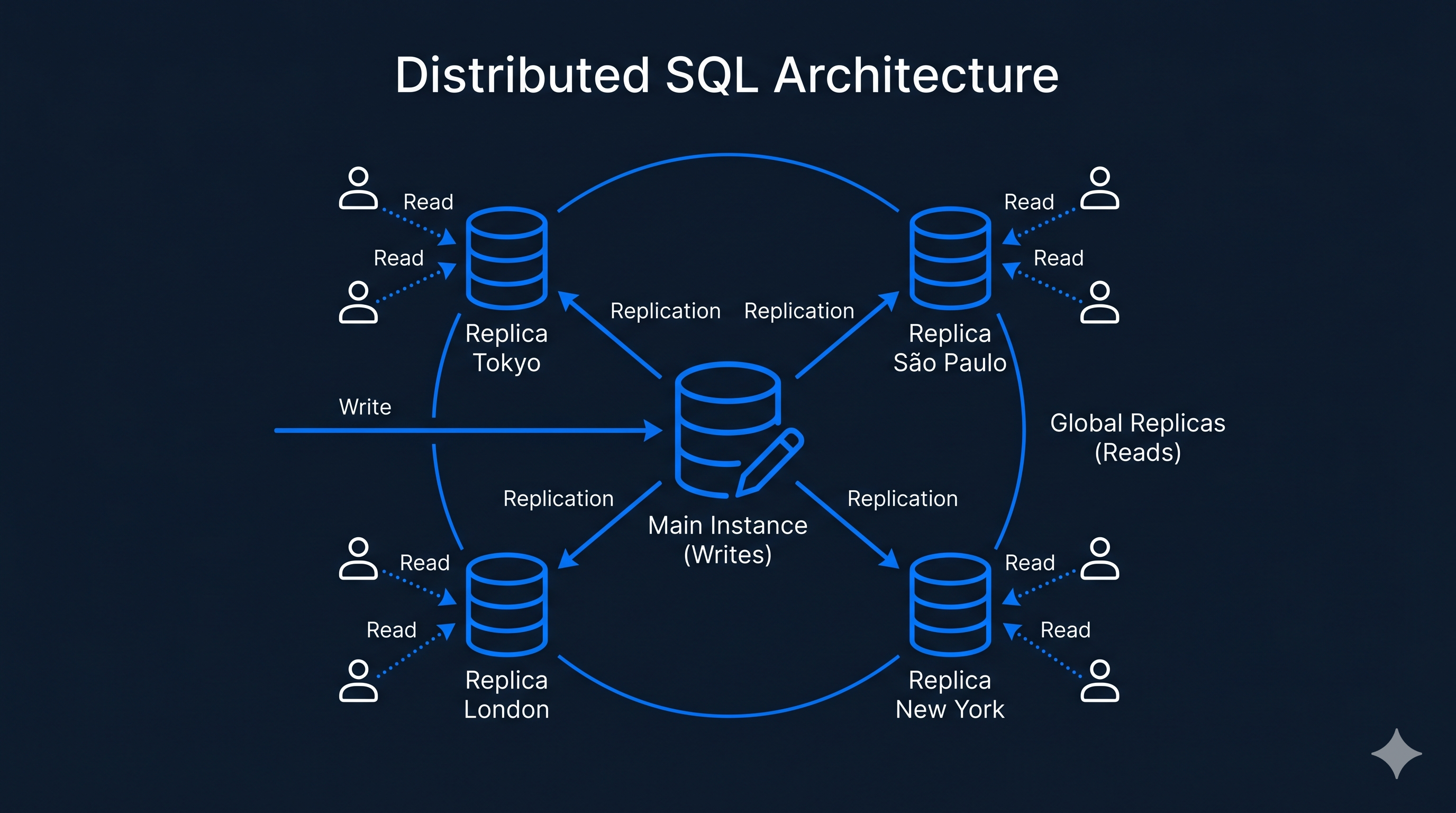
Distributed SQL databases use a synchronization model that balances write consistency with read performance.
The Main Instance (The Writer)
All write operations — inserting, updating, or deleting data — route to a primary “main” instance. This centralization ensures data integrity and prevents write conflicts that could occur if multiple locations tried to modify the same record simultaneously.
The main instance acts as the single source of truth for mutations. Applications send write queries here, and the main instance applies changes transactionally.
Global Replicas (The Readers)
The platform automatically replicates your data to read-only database instances distributed across global locations. These replicas sit close to your users, often within milliseconds of network distance.
When a user requests data, the query resolves at the nearest local replica. No long network hops. No overloaded central database. The replica serves the result instantly.
The Result: Global Low-Latency Reads
This architecture transforms query performance. A user in Tokyo reads from a Tokyo replica. A user in São Paulo reads from a São Paulo replica. Both experience near-zero latency for read operations, while writes remain consistent through the main instance.
A New Era: Integrating Vector Search and AI
Serverless SQL databases now support workloads that previously required separate, specialized systems.
What is Vector Search?
Traditional search looks for exact keyword matches. Vector search uses mathematical representations called vector embeddings — arrays of floating-point numbers that capture meaning and context.
When you search for “running shoes,” vector search finds semantically similar items: “jogging sneakers,” “athletic footwear,” “marathon trainers.” It understands meaning, not just keywords.
Storing Vectors in SQL
Modern serverless databases store these vectors directly alongside structured data in standard SQL tables. You don’t need a separate, expensive vector database. A single table can hold product names, prices, and vector embeddings for semantic search.
CREATE TABLE products ( id INTEGER PRIMARY KEY, name TEXT, price REAL, embedding BLOB);RAG: Retrieval-Augmented Generation
This architecture enables RAG (Retrieval-Augmented Generation) — the foundation of modern AI applications. When an AI model needs context to answer a question, it queries your database for semantically relevant information using vector similarity.
A simple SQL query fetches the most relevant documents, which the AI model uses to generate accurate, contextual responses. No separate infrastructure. No complex integrations. Just SQL.
Simple Code Example
Querying a distributed serverless SQL database looks familiar. Here’s a JavaScript example using a standard query interface:
import { useQuery } from "database-library";
async function handleRequest(request) {  try {    // Query the globally distributed replica using standard SQL    const { data, error } = await useQuery("products_db",      "SELECT * FROM products WHERE category = ? LIMIT 10",      ["electronics"]    );
    if (error) {      return new Response("Database error", { status: 500 });    }
    return Response.json(data);  } catch (err) {    return new Response(err.message, { status: 500 });  }}
The query executes at the nearest replica. Your code remains simple while the infrastructure handles distribution, replication, and latency optimization automatically.
Practical Use Cases for Serverless SQL
Serverless SQL excels in scenarios where read performance, global distribution, and operational simplicity matter.
User Profiles and Personalization
Store user preferences, themes, and settings globally. When a user logs in, their profile loads from the nearest replica with near-zero latency. Personalized pages render instantly, improving engagement and conversion.
Dynamic Content Catalogs
Power e-commerce inventory, blog articles, or redirect tables that require instant global reads but update occasionally. Product catalogs, pricing tables, and content libraries benefit from distributed read access while maintaining a single write source.
Semantic Search and AI Applications
Match user questions to semantic context in real-time. Build intelligent search engines, recommendation systems, and AI agents that query vector embeddings alongside structured data — all from a single database.
Frequently Asked Questions
What are the execution limits of SQL in distributed environments?
Serverless SQL platforms enforce reasonable limits to ensure optimal performance. Query duration typically caps at around 30 seconds, and result sets may have size limits. These constraints encourage efficient query design and prevent runaway operations.
Does Serverless SQL completely replace traditional databases?
Not always. Serverless SQL excels for read-heavy global applications and workloads with variable traffic. Complex multi-region write-heavy transactional systems may still benefit from traditional database clusters optimized for high-volume writes.
Can I store images or files in a serverless SQL database?
Relational databases are optimized for structured data and vectors — not raw files. The best practice is to store images, videos, PDFs, and other binary files in S3-compatible Object Storage, then keep only their metadata or reference URLs inside your SQL database tables. This separation optimizes query performance, reduces storage costs, and keeps your database focused on what it does best.
How do backups work in a distributed main/replica setup?
To guarantee immediate data consistency and integrity, backups should always be generated directly from the primary “Main” instance (where writes occur). Since replication to global replicas is eventually consistent, taking backups from replicas could result in incomplete or stale snapshots.
Can I import my existing database into a serverless distributed database?
Yes. Modern developer tools include simple CLI commands and shell utilities — including an interactive SQL shell — to import data easily from local files (CSV, XLSX), standard SQLite backups, MySQL dumps, or PostgreSQL exports. Migration paths exist for most common database formats, making the transition straightforward for developers.
Conclusion
Serverless SQL removes the operational burden of database management. No server provisioning. No capacity planning. No patching schedules. Developers focus on writing code while the platform handles scaling, replication, and distribution.
Modern serverless SQL architectures can be fully managed via CLI tools, bringing database administration directly into developers’ local, terminal-based workflows. This developer experience (DX) shift means you can create databases, run migrations, and inspect schemas without leaving your terminal.
The combination of familiar SQL syntax, global low-latency reads, and native vector support opens new possibilities for modern applications. From personalized user experiences to AI-powered search, serverless SQL provides the foundation for building faster, smarter, globally distributed systems.
Explore distributed database to start building with serverless SQL today.