STORE
SQL Database
Scale effortlessly and boost your application's global performance with our distributed, serverless SQL Database.

_
read latency from global replicas
_
locations with distributed reads
_
ACID compliance on primary instance
Global reads, local latency
Replicas close to users reduce RTT and speed up SQL queries, keeping data close to consumers.
Built-in resilience
Continuous replication and automatic failover keep your applications online with high availability.
Cost efficiency
Pay for storage and operations; distributed reads offload your application and reduce costs.
Distributed SQL, high availability, and global reads in milliseconds.
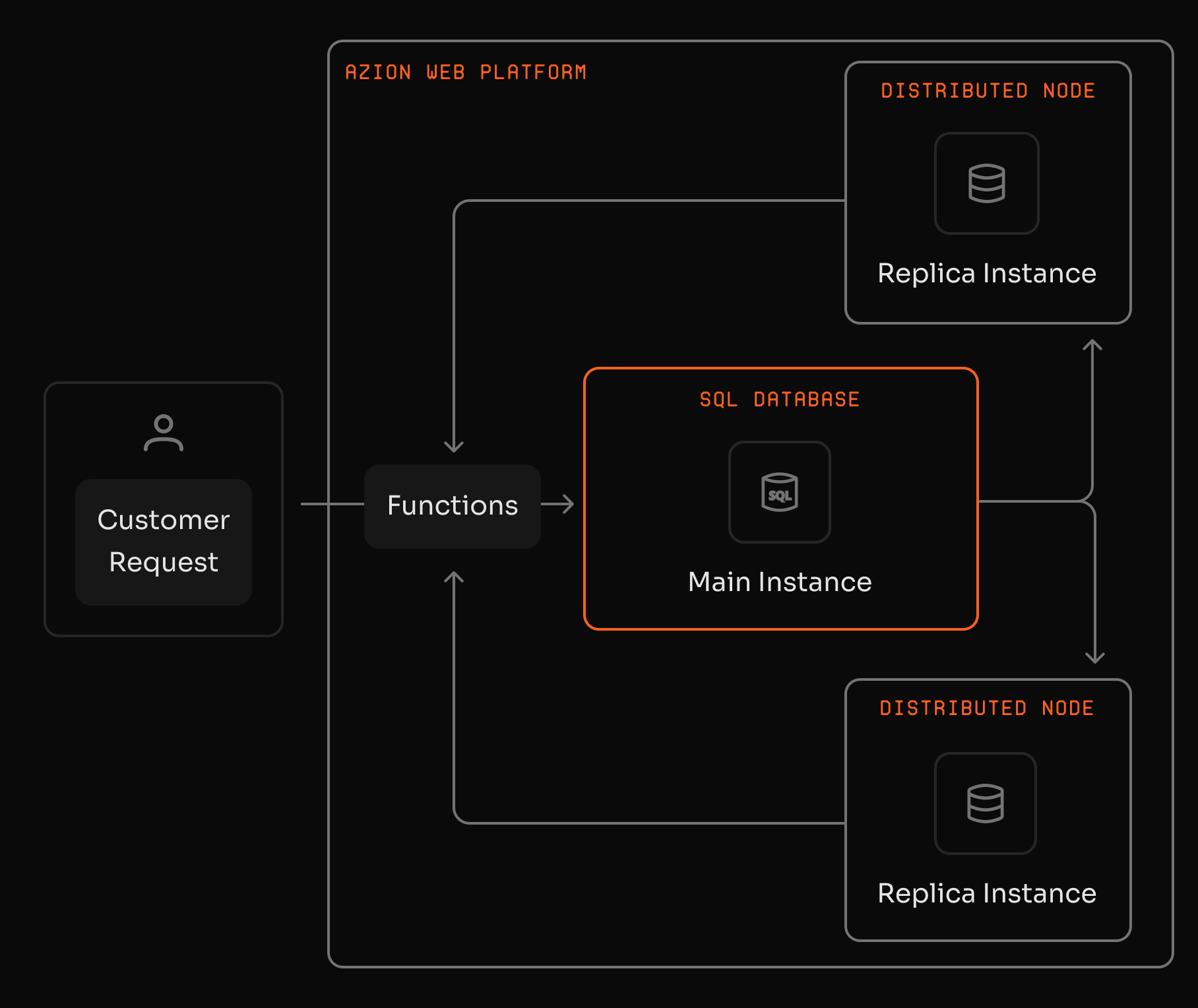
Distributed SQL architecture
Primary instance processes all writes and automatically replicates to read replicas in global data centers.
ACID guarantees on the primary instance; SQLite compatibility on infrastructure based on libSQL.
SQLite compatibleACID guaranteesRead replicasFunctions API

LibSQL with built-in vector search
Run standard SQL and vector operations with up to 65,536 dimensions.
Native support for cosine distance and ANN for semantic similarity queries inside SQL.
Hybrid processing combines relational SQL and vector search for RAG, recommendation, and ranking.
Vector search65K dimensionsRAG supportHybrid queries

See how to use
Frequently Asked Questions
What is SQL Database?
Azion SQL Database is a serverless, distributed SQL solution. Key features include: sub-20ms read latency from global replicas, ACID compliance on primary instance, SQLite/libSQL compatibility, vector search with up to 65,536 dimensions, and native Functions integration. Build RAG apps, authentication systems, and low-latency APIs.
How does SQL Database replicate data?
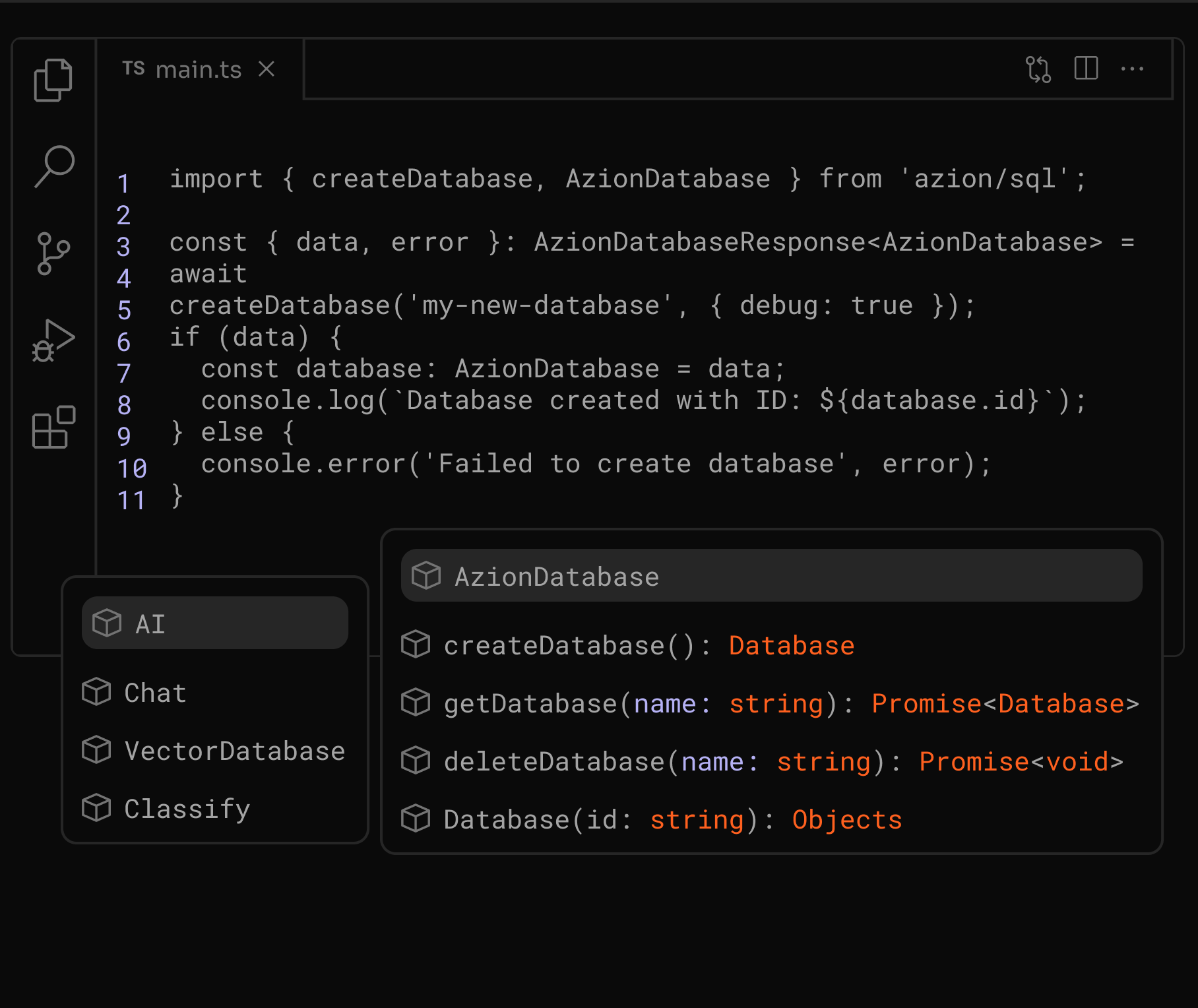
SQL Database uses a Main/Replicas architecture. Writes happen on the main instance and data is propagated to read replicas on distributed infrastructure.
Can I write to replicas?
No. Replicas are read-only. Writing data is only possible on the main instance, either via the REST API or via Functions.
Are replicas immediately consistent with the main instance?
No. Replicas are updated with a propagation time, so they eventually become in sync with the main instance rather than updating instantly.
How do I query SQL Database from Functions?
Functions can open a connection to a read replica and run SQL queries and commands. This is useful for low-latency reads and request-time decisions.
Can I manage databases with an API?
Yes. You can create, list, query, and delete databases using the SQL Database REST API. Database creation may take a few minutes before it's ready to use.
What happens if I delete a database?
Deleting a database can't be undone. After deletion, you can no longer read from or write to that database.
What are the default limits for SQL Database?
Default limits include up to 100 columns per table and a maximum SQL query duration of 30 seconds. Database count and storage limits depend on your service plan.
What is Vector Search in SQL Database?
Vector Search enables semantic search using vector embeddings stored in SQL Database. It supports cosine distance calculations and indexing for approximate nearest neighbor queries.
Is there a limit on vector dimensions?
Yes. Vector operations can be performed on vectors with up to 65,536 dimensions.