


Infrastructure agility matters. Today, we’re excited to announce a major milestone in our commitment to Infrastructure as Code (IaC): the official migration of the Azion Terraform Provider to API v4.
This update represents more than a version bump. This represents a fundamental shift in how we build, deliver, and maintain our provider, ensuring you always have access to the latest Azion capabilities with zero delay.
Beyond Parity: A Comprehensive Resource Ecosystem
The transition to API v4 allowed us to move beyond the limitations of the previous version. While the v3 provider focused on core delivery settings, the new v4-based provider encompasses nearly the entire Azion product suite. We didn’t just migrate existing resources; we expanded the ecosystem to include critical security and management APIs that were previously unavailable.
Intelligence in the Pipeline: AI-Driven Automation
The most significant innovation in this release is how the provider is built. To solve the historical problem of “provider lag”, where IaC tools fall behind API updates, we implemented a sophisticated, automated pipeline driven by AI and autogenerated SDKs.
The Design-First Automation Pipeline
Our automation is rooted in the “Design-First” philosophy: the OpenAPI specification for our API v4 is the single source of truth for all downstream artifacts. This approach ensures consistency across all tools and documentation.
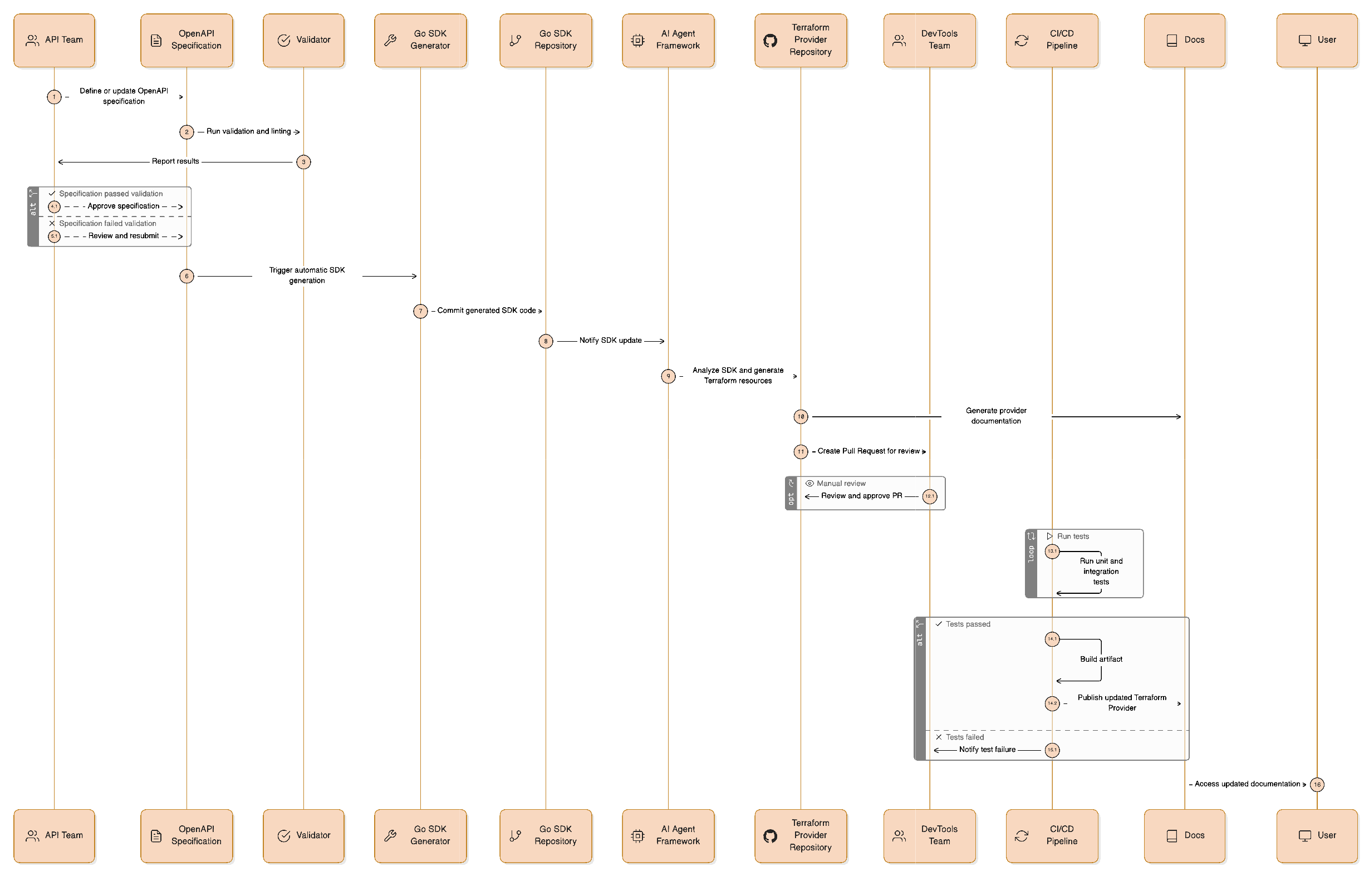
The process follows a tight, automated loop, guaranteeing that our Terraform Provider stays in sync with the latest Azion API:
- API Contract (OpenAPI): Every new feature starts with defining the OpenAPI specification, which is validated by the API team and goes through linters and tests.
- SDK Autogeneration: The approved OpenAPI specification is used to automatically generate the Go SDK. This ensures the SDK is a faithful reflection of the latest API contract.
- AI Agent Analysis: We created a framework using Agent specifications that fully describes the format of our Terraform Provider. This enables the AI Agent to generate updates, fix bugs, and add new data sources and resources based on the provided Autogenerate SDK or even a manually provided yaml file. A fully automatic generation process is also in development.
- Terraform Resource Creation: The AI agent analyzes the updated Go SDK and autonomously generates or updates the corresponding Terraform resource code and documentation. This method is a key part of our strategy for rapidly onboarding new APIs.
- Day-0 Release: By tightly linking the OpenAPI spec, SDK, and Terraform provider, we can release updates almost instantly after an API change, providing Day-0 support for new features.
- Architecture Flow: This automation ensures that the Terraform Provider remains a faithful and up-to-date reflection of the Azion API v4, eliminating manual errors and accelerating your deployment cycles.
Designed for Scale and Reliability
The new provider emphasizes quality, not just quantity. We’ve introduced several architectural improvements to enhance the developer experience:
- Internal Resource Referencing: Say goodbye to manually copying IDs. The v4 provider allows for seamless internal referencing—for example, obtaining an application_id directly from the resource—which greatly improves the reliability of complex orchestrations. This stems from the idea that every Product is now implemented within our Provider.
- Built-in Safety: By leveraging API v4’s modern architecture, we’ve resolved many legacy issues related to resource propagation and dependency management.
Getting Started
The future of Web infrastructure is automated. We invite you to explore the new provider, which is already available in the Terraform Registry and in our public repository.
- Install the new Azion Terraform Provider (2.x.x)
- Explore the Repository: [Azion Terraform Provider v4]
- Read the Documentation: Detailed guides and resource documentation are being centralized within the repository to be sure they’re always as current as the code itself. Official documentation is also coming soon to our website.
As we move forward, our AI-driven agents will continue to evolve, ensuring that Azion remains the most developer-friendly and automated Web platform in the industry.