Migrate from AWS to Azion
A comprehensive technical reference for engineering teams evaluating AWS competitors. Includes detailed product mapping tables, configuration examples, and step-by-step procedures to migrate CloudFront, Lambda, S3 storage, AWS WAF, and AWS Shield workloads.
Unified platform
Replace CloudFront, Lambda, S3, and DynamoDB with one integrated platform. Applications, Functions, Object Storage, and KV Store work together seamlessly.
Simplified pricing
No egress fees between services, transparent pay-as-you-go pricing, and no hidden costs for data transfer—a clear contrast with AWS S3 pricing tiers and data transfer charges.
Edge-native architecture
Built for distributed computing from the ground up with sub-30ms latency across 120+ locations worldwide.
Take the migration guide with you
Download the full ebook to plan and execute your migration offline. Share it with your team, review architecture decisions on your own time, and use it as a reference throughout every stage of the transition from AWS to Azion.Download PDF
Migrate without rearchitecting
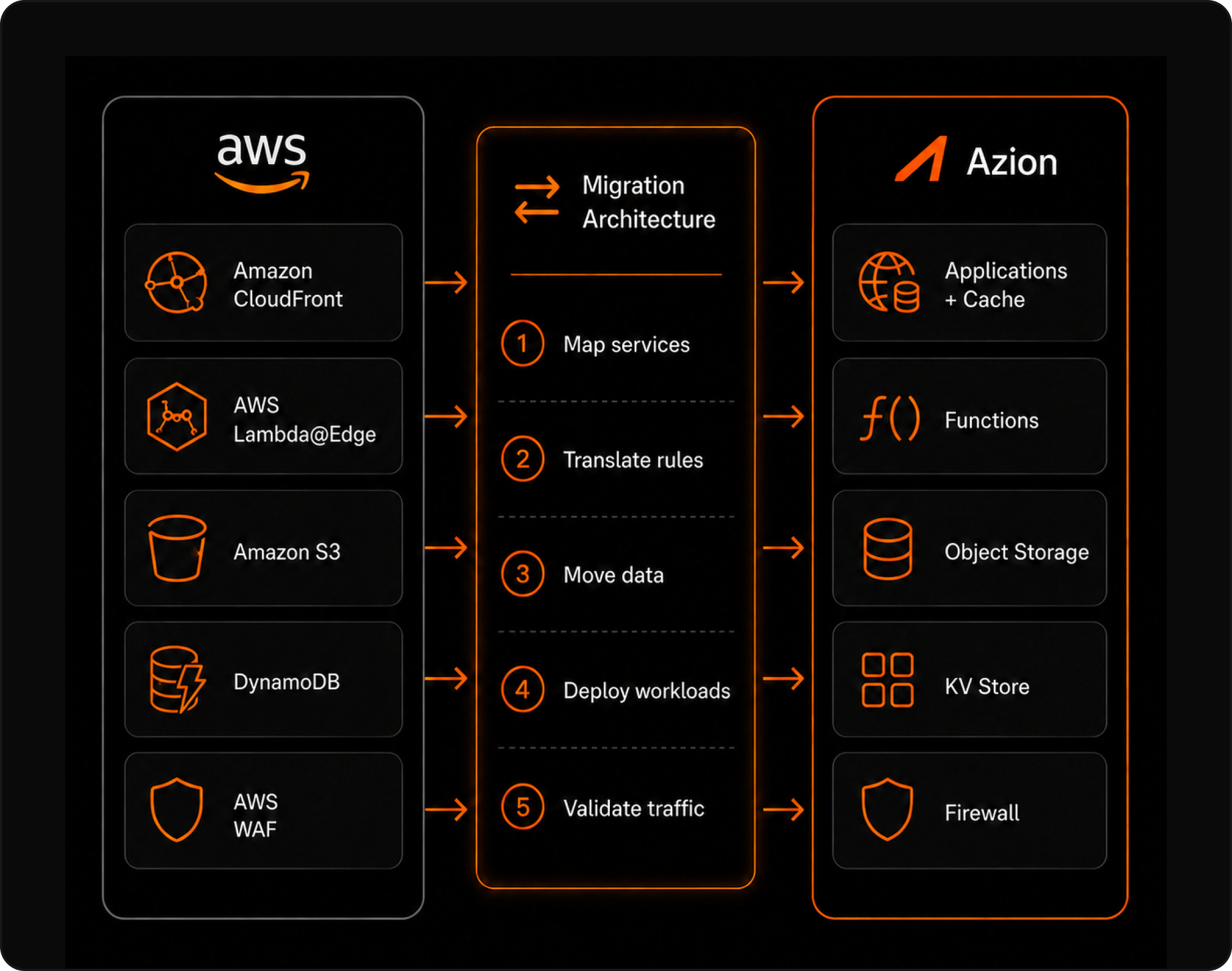
AWS configurations map directly to Azion equivalents. CloudFront behaviors become Rules Engine rules, Lambda functions run on Functions, S3 buckets sync to Object Storage, and DynamoDB tables migrate to KV Store—all using compatible APIs and familiar patterns. AWS WAF rules and AWS Shield protections translate to Azion WAF and DDoS Protection.Complete Migration Guide
Zero cold starts
Consistent first-request performance with no cold start latency. Functions execute immediately on Azion's distributed infrastructure.
Extended execution time
Up to 5 minutes of CPU time per execution versus AWS Lambda's time limits. Run complex workloads without splitting logic.
Native SQL Database
Built-in distributed SQL with ACID compliance and global read replicas—no external database required.
Frequently Asked Questions
How do CloudFront distributions map to Azion Applications?
CloudFront distributions become Azion Applications with equivalent capabilities. Cache behaviors map to Rules Engine rules, origins become configured endpoints, and TLS certificates are managed through Certificate Manager. The migration preserves your routing logic and cache policies.
What's the equivalent of Lambda and Lambda@Edge?
AWS Lambda and Lambda@Edge functions migrate to Azion Functions. Functions support TypeScript and JavaScript with web-standard APIs and Node.js polyfills. You get up to 5 minutes of CPU time per execution and zero cold starts—improving on Lambda's limitations.
How do I migrate S3 buckets to Azion?
S3 buckets migrate to Azion Object Storage using S3-compatible APIs. Your existing code and tools work with minimal changes. Object Storage integrates natively with Applications for edge delivery and Functions for transformation logic.
Is there an equivalent to DynamoDB?
Yes. Azion KV Store provides a serverless key-value database similar to DynamoDB. For relational data, SQL Database offers distributed SQL with ACID compliance and global read replicas—capabilities that require multiple AWS services to achieve.
How does pricing compare to AWS?
Azion offers transparent pay-as-you-go pricing with no egress fees between services. You pay only for what you use with no hidden data transfer costs. Start with $300 in free credits valid for 365 days—no credit card required.
How does Azion Object Storage compare with AWS S3 pricing?
Azion Object Storage is one of the leading S3 competitors, with S3-compatible APIs and no egress fees between Azion services. While AWS S3 pricing adds charges for storage tiers, requests, and data transfer out, Azion offers transparent pay-as-you-go storage that integrates natively with delivery and compute.
Can I run both platforms during migration?
Yes. You can run AWS and Azion simultaneously and gradually shift traffic using DNS configuration. This allows for testing, validation, and a smooth transition without service interruption.
What about WAF and security rules?
AWS WAF rules migrate to Azion Web Application Firewall and Firewall products. Managed rule sets, custom rules, rate limiting, and bot detection all have equivalents. DDoS protection—the role AWS Shield plays on AWS—is built-in with no additional configuration or per-resource fees.
How do I migrate Route 53 DNS?
Route 53 hosted zones migrate to Azion Edge DNS. Import your records, validate propagation, then update your domain register to use Azion's nameservers. Health checks and routing policies have equivalent capabilities.
Access to all features.
$300 free credits